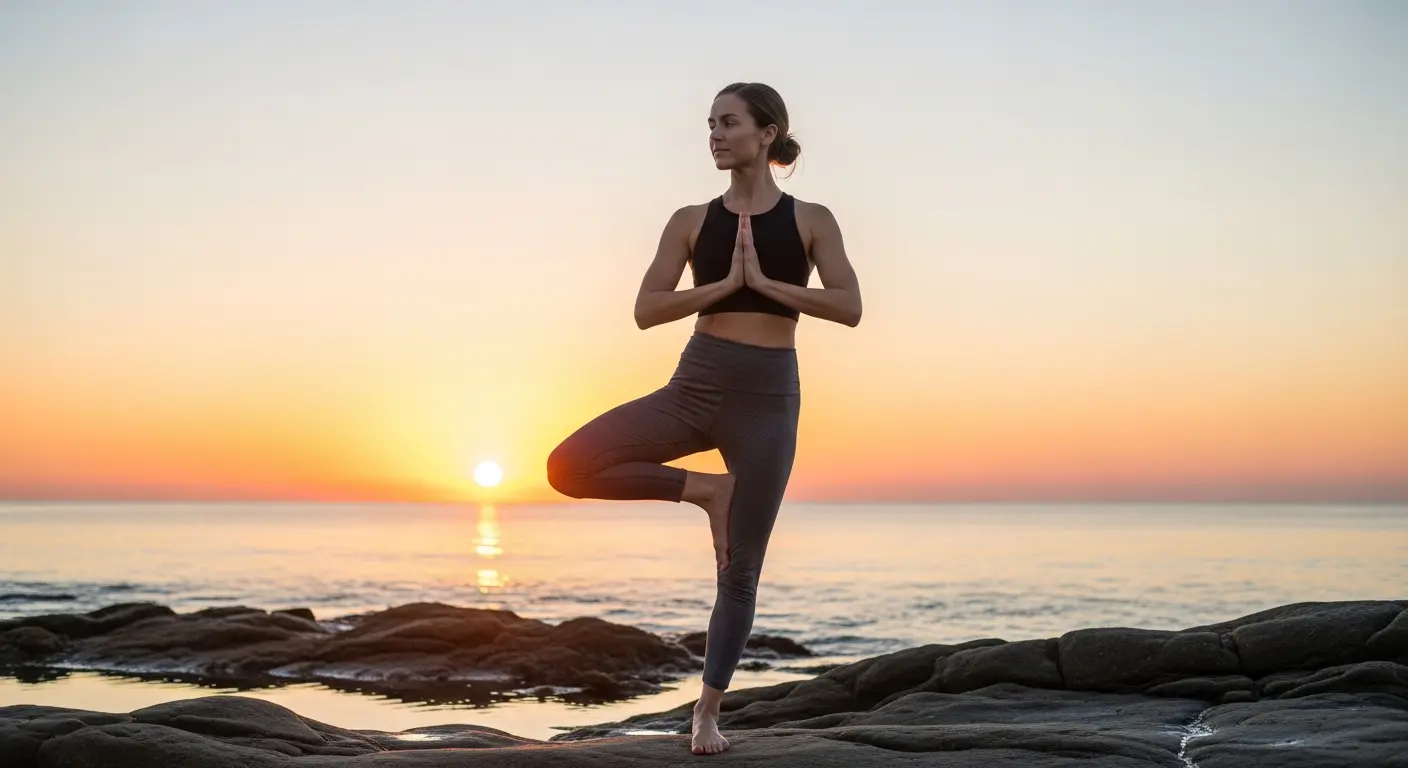
Improving balance and stability is a common goal for students who have moved past the basics but are not yet advanced. This guide gives five targeted, practical strategies to help advanced beginners progress with safe, measurable steps.
Why Build Balance and Stability Matters
Balance and stability reduce the risk of falls, support stronger alignment, and enable more advanced yoga shapes. For yoga practice, they create a reliable base for standing poses, arm balances, and transitions.
Developing these skills also carries over to daily activities, improving posture and movement confidence outside the studio.
Common balance challenges for advanced beginners
- Wobbly standing poses and difficulty holding for several breaths.
- Overreliance on the supporting leg or dominant side.
- Weak hip or core engagement that allows the torso to sway.
5 Advanced Beginner Yoga Tips to Build Balance and Stability
1. Prioritize the foundation: feet, knees, hips
Strong balance begins at the feet. Spread toes, grip the mat lightly, and distribute weight evenly across heel, ball, and outer edge. Small changes at the foot radically affect the standing line above.
For the knees and hips, keep a soft micro-bend when needed to avoid locking joints. Maintain neutral hip alignment by engaging the pelvic floor and slightly tucking the tailbone to stabilize the center.
2. Train proprioception with micro-movements
Proprioception is your body’s sense of position. Improve it with small, controlled shifts in standing poses. Try tracing tiny circles with the hips or nudging weight slightly forward and back while holding Tree Pose for six to eight breaths.
Practice with eyes open, then with eyes closed to challenge the system. Start with short exposures—5–10 seconds closed eyes—and build gradually.
3. Use props and progressive support
Props let you practice safe alignment while building strength. Use a wall, block, or chair to support the first phase of a pose. For example, practice Half Moon with a block under the supporting hand before removing the block.
Progress by reducing support in stages: full support, partial support, fingertip touch, then no support. Track progress in a simple journal to stay objective.
4. Strengthen the core and hip stabilizers
Balance relies on a stable center. Add targeted strengthening for the transverse abdominis, obliques, glutes, and hip abductors. Exercises can be integrated into yoga practice or done separately.
- Yoga moves: Boat Pose (Navasana) variations, Forearm Plank holds, and Side Plank with leg lift.
- Supplemental work: Clamshells, single-leg bridges, and standing hip abduction with resistance band.
Perform 2–3 sets of 8–15 reps for strengthening moves, and hold planks for timed intervals to build endurance.
5. Coordinate breath and balanced action
Breath stabilizes the nervous system and supports steady muscle engagement. Link slow, even inhales and exhales to movement and balance checks. Exhale to engage core and find length, inhale to soften and observe alignment.
Use counts to structure practice: 4-count inhale, 4-count exhale while holding a balancing pose. If wobble increases, return to a neutral breath pattern and reset the base.
Balance ability naturally declines with age, but consistent yoga practice that targets proprioception and hip strength can reverse measurable losses in stability within weeks.
Simple practice plan to build balance and stability
Consistency matters more than intensity. Follow a structured plan three times per week to see steady improvement. Combine focused balance drills with general yoga flows.
- Session A (30–40 minutes): Warm-up, footwork drills, standing balance sequence, 10 minutes core work.
- Session B (30 minutes): Proprioception work with eyes-closed practice, hip strengthening, restorative cool-down.
- Session C (20–30 minutes): Flow with emphasis on controlled transitions and breath coordination.
Real-world example: Emma’s 8-week progress
Emma, a 38-year-old yoga student, practiced three sessions weekly following the plan above. She began unable to hold Tree Pose for more than 10 seconds on her left side.
After eight weeks, Emma reported holding Tree Pose for 45 seconds on both sides and added single-leg RDLs to her practice. She tracked improvements with a simple timer and noted reduced ankle wobble and less pain in the right hip.
Quick tips for safer progress
- Warm up joints before balance work; cold muscles make stability harder.
- Reduce external distractions when training balance to focus proprioception.
- Record short videos occasionally to check alignment and symmetry.
- Be patient: progress is often small and cumulative.
Building balance and stability as an advanced beginner is a deliberate process that combines foundation work, strength, proprioception, and breath. Apply these five tips with regular practice and track changes weekly. Small, consistent adjustments lead to reliable gains and safer progress into more advanced poses.